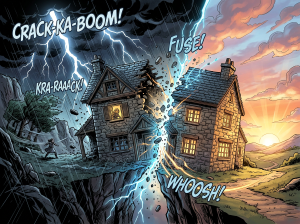
Every generation tries to fix what only God can restore.
We build stronger institutions, improve our education, reform governments, strengthen families, and even reorganize churches. Each effort may accomplish something worthwhile, yet the deeper fracture remains. Scripture tells us why.
The Bible does not begin with the creation of a nation, a temple, or a church. It begins with a household.
Adam and Eve lived openly before God. They walked with Him, trusted Him, and shared life together. Divine order was not first a system of rules or an organizational structure. It was a relationship with the Creator that naturally shaped every other relationship.
Then trust was broken.
The first consequence of sin was not simply disobedience. Adam and Eve hid from God. They hid from one another behind fig leaves. Adam blamed Eve. Eve blamed the serpent. A fractured relationship with God quickly became fractured relationships with people.
The pattern continued.
Cain murdered Abel. Families became divided. Violence filled the earth before the flood. After the flood, humanity united at Babel—not in submission to God, but in pursuit of its own greatness. Israel repeatedly drifted from covenant faithfulness while preserving the outward forms of religion. The prophets compared their unfaithfulness to marital betrayal.
By the time Jesus came, many faithfully maintained religious traditions while missing the One to whom those traditions pointed.
The fracture had never been merely institutional.
It was relational.
That same pattern continues today. We often believe the solution lies in finding the right denomination, the right pastor, the right worship style, or the right theological system. While these things have value, they cannot repair what was broken in Eden.
The deepest problem is not that people lack religion.
It is that people have become separated from the Father.
This is why the gospel is far more than the forgiveness of individual sins. Through Jesus Christ, God restores people to Himself. The New Testament repeatedly describes believers as sons and daughters, members of God’s household, and fellow citizens in His kingdom.
The church is not simply an organization people attend. It is the household of God.
This changes how we understand Christian life. Obedience becomes the fruit of relationship rather than the price of acceptance. Fellowship becomes participation in a shared life rather than merely attending the same building. Authority becomes servant leadership rather than control. Grace becomes God’s restoring work rather than permission to remain unchanged.
The world around us reflects the same fracture that began in Genesis. Broken marriages, divided families, lonely individuals, polarized communities, and even fractured churches all testify that something deeper has gone wrong.
Scripture does not leave us there.
Jesus entered the broken household of humanity to bring us home.
He did not merely establish another religious system. He revealed the Father. He gathered those who were scattered. He reconciled sinners to God and to one another. Through His death and resurrection, He opened the way back into the household for which humanity was originally created.
The invitation of Scripture has never changed.
Return to the Father.
When our relationship with Him is restored through Christ, every other relationship begins to find its proper place. This is the restoration of divine order—not the triumph of human systems, but the renewal of life with God through His Son.
As the Apostle Paul reminds us, “For from Him and through Him and to Him are all things. To Him be the glory forever. Amen” (Romans 11:36, NASB95).
Michael Kovach
Covenant Light Publishing
All Rights Reserved
