Did You Know
Understanding 1 Corinthians 13:10-13
First Corinthians 13 is probably one of the most familiar chapters in the New Testament. It is read at weddings, printed on greeting cards, and frequently quoted whenever Christians discuss love. Yet when Paul wrote these words, he was doing considerably more than providing a beautiful description of human affection. Near the conclusion of the chapter, he writes, “But when the perfect comes, the partial will be done away. When I was a child, I used to speak like a child, think like a child, reason like a child; when I became a man, I did away with childish things. For now we see in a mirror dimly, but then face to face; now I know in part, but then I will know fully just as I also have been fully known. But now faith, hope, love, abide these three; but the greatest of these is love” (First Corinthians 13:10–13).
There are several words here worth slowing down to examine. The Greek word translated “perfect” is τέλειον (𝘵𝘦𝘭𝘦𝘪𝘰𝘯), from the word family associated with τέλος (𝘵𝘦𝘭𝘰𝘴), an end, goal, completion, or intended outcome. Depending upon its context, τέλειος (𝘵𝘦𝘭𝘦𝘪𝘰𝘴) can carry the sense of complete, mature, fully developed, or having reached its intended goal. This matters because Paul contrasts τὸ τέλειον (𝘵𝘰 𝘵𝘦𝘭𝘦𝘪𝘰𝘯), “the perfect” or “the complete,” with ἐκ μέρους (𝘦𝘬 𝘮𝘦𝘳𝘰𝘶𝘴), “in part.” His movement is from what is 𝗽𝗮𝗿𝘁𝗶𝗮𝗹 toward what is 𝗰𝗼𝗺𝗽𝗹𝗲𝘁𝗲.
Paul immediately illustrates the same movement by describing childhood and maturity. “When I was a child,” he says, he spoke, thought, and reasoned as a child. When he became a man, however, he put away childish things. Paul is not criticizing children. He is describing development. Childhood is appropriate for a child, but it is not the intended destination. Something partial is moving toward maturity.
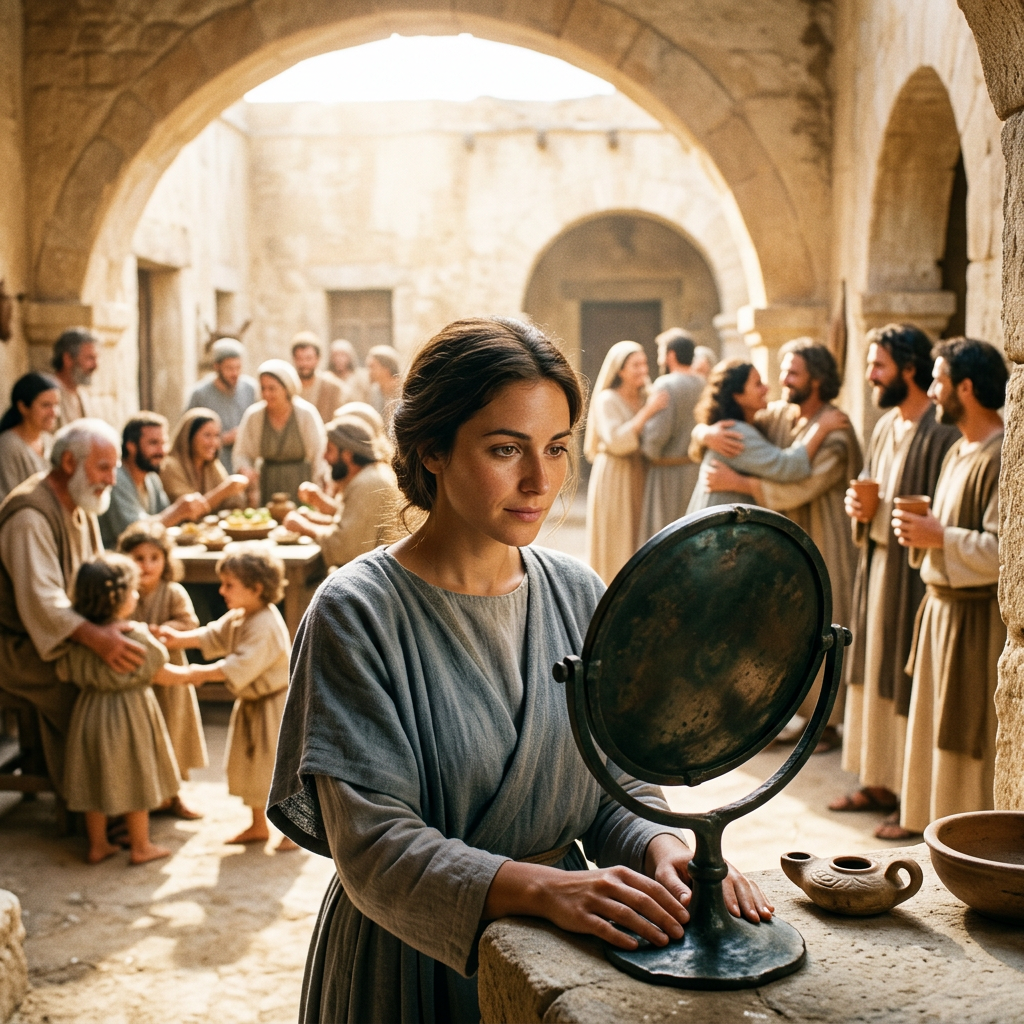
Then Paul changes the picture: “For now we see in a mirror dimly, but then face to face.” The Greek expression translated “face to face” is πρόσωπον πρὸς πρόσωπον (𝘱𝘳𝘰𝘴ō𝘱𝘰𝘯 𝘱𝘳𝘰𝘴 𝘱𝘳𝘰𝘴ō𝘱𝘰𝘯), literally “face toward face.” That expression belongs to a much older scriptural vocabulary. After wrestling at Peniel, Jacob declares, “I have seen God face to face” (Genesis 32:30). Exodus tells us, “Thus the LORD used to speak to Moses face to face, just as a man speaks to his friend” (Exodus 33:11). Paul therefore moves from seeing indistinctly toward the language of direct encounter and clearer perception.
Paul continues, “Now I know in part, but then I will know fully just as I also have been fully known.” Again, the movement is from partial knowledge toward fuller knowledge. Paul first uses γινώσκω (𝘨𝘪𝘯ō𝘴𝘬ō), “to know,” and then the intensified verb ἐπιγινώσκω (𝘦𝘱𝘪𝘨𝘪𝘯ō𝘴𝘬ō), which can carry the sense of knowing, recognizing, or knowing more fully. Throughout these verses the direction remains consistent: partial toward complete, childhood toward maturity, dim reflection toward face-to-face encounter, and partial knowledge toward fuller knowledge.
Then Paul arrives at his remarkable conclusion: “But now faith, hope, love, abide these three; but the greatest of these is love.” The Greek word translated “love” is ἀγάπη (𝘢𝘨𝘢𝘱ē). Older English translations, most famously the King James Version, rendered the word “charity”: “And now abideth faith, hope, charity, these three; but the greatest of these is charity.” The Greek did not change. 𝗘𝗻𝗴𝗹𝗶𝘀𝗵 𝗱𝗶𝗱.
The English word “charity” came through the Latin 𝘤𝘢𝘳𝘪𝘵𝘢𝘴 and once carried a much broader sense of Christian love, affection, and loving regard. Over time, however, its common English meaning narrowed until “charity” became associated primarily with benevolent giving or helping those in need. Modern translations therefore generally use “love” because it communicates ἀγάπη more clearly to contemporary English readers.
Yet our modern word “love” creates another possible misunderstanding. We can hear “love” and immediately think of emotion, romance, affection, attraction, or personal preference. Paul does not permit us to define ἀγάπη that narrowly because he has already spent the chapter telling us what it looks like. “Love is patient, love is kind and is not jealous; love does not brag and is not arrogant” (First Corinthians 13:4). The noun is ἀγάπη (𝘢𝘨𝘢𝘱ē), “love,” while its corresponding verb is ἀγαπάω (𝘢𝘨𝘢𝘱𝘢ō), “to love.” Paul does not merely tell us what love feels like. He shows us what love does.
Love is patient and kind. Love does not seek its own advantage. Love does not keep an account of wrongs. Love does not rejoice in unrighteousness but rejoices with the truth. Love bears, believes, hopes, and endures. Finally, Paul makes the extraordinary statement, “Love never fails” (First Corinthians 13:8). His description is behavioral and relational. ἀγάπη becomes visible in the way one acts toward another.
At this point another scriptural witness becomes especially important. John writes, “God is love” (First John 4:8). The Greek is ὁ θεὸς ἀγάπη ἐστίν (𝘩𝘰 𝘵𝘩𝘦𝘰𝘴 𝘢𝘨𝘢𝘱ē 𝘦𝘴𝘵𝘪𝘯): 𝗚𝗼𝗱 𝗶𝘀 ἀγάπη. Paul does not explicitly introduce First Corinthians 13 by saying, “I am describing God,” and we should not place those words in his mouth. Nevertheless, when John explicitly testifies that God is ἀγάπη, Paul’s description of the character of ἀγάπη necessarily gives us something to consider about the character of God.
Paul himself strengthens that connection elsewhere when he writes, “Therefore be imitators of God, as beloved children; and walk in love” (Ephesians 5:1–2). The Greek word translated “imitators” is μιμηταί (𝘮𝘪𝘮ē𝘵𝘢𝘪). Paul tells God’s children to imitate their Father, and he immediately connects that imitation with walking in ἀγάπη. Jesus had already established a similar pattern when He commanded His disciples to love their enemies and pointed them toward their heavenly Father, who gives sun and rain to the righteous and unrighteous alike (Matthew 5:43–48).
The scriptural witnesses therefore begin to form a coherent picture. God is love. God’s character demonstrates love. God’s children are instructed to imitate their Father by walking in love. Paul describes what that love looks like when expressed in relationship with others. First Corinthians 13 consequently becomes much more than a passage suitable for weddings. It describes the kind of life God’s children are being called to embody as they mature.
Now Paul’s closing statement becomes even more interesting: “Faith, hope, love, abide these three; but the greatest of these is love.” Why is love the greatest? Paul does not explicitly explain his final comparison here, so we should be careful not to transform inference into revelation. Yet Scripture gives us something remarkable to ponder. Faith trusts God. Hope looks toward what God has promised. But Scripture explicitly declares that 𝗚𝗼𝗱 𝗶𝘀 𝗹𝗼𝘃𝗲.
Perhaps this helps us understand why, after describing everything partial moving toward completion, Paul leaves love standing above everything else. We presently know in part. We presently see dimly. We are still moving from childhood toward maturity. Our understanding remains incomplete. Yet throughout that growth, Paul directs us toward something that “never fails.”
First Corinthians 13 may therefore be inviting us to consider not merely what love is, but both 𝘄𝗵𝗼 𝗚𝗼𝗱 𝗶𝘀 and 𝘄𝗵𝗼 𝘄𝗲 𝗮𝗿𝗲 𝗯𝗲𝗰𝗼𝗺𝗶𝗻𝗴 𝗮𝘀 𝘄𝗲 𝗶𝗺𝗶𝘁𝗮𝘁𝗲 𝗛𝗶𝗺.
Perhaps the deepest question this familiar chapter leaves with us is not simply, “Do I understand what love means?” It may be something considerably more personal:
𝗔𝘀 𝗜 𝗴𝗿𝗼𝘄 𝘁𝗼𝘄𝗮𝗿𝗱 𝗺𝗮𝘁𝘂𝗿𝗶𝘁𝘆 𝗶𝗻 𝗖𝗵𝗿𝗶𝘀𝘁, 𝗮𝗺 𝗜 𝗶𝗻𝗰𝗿𝗲𝗮𝘀𝗶𝗻𝗴𝗹𝘆 𝗿𝗲𝗳𝗹𝗲𝗰𝘁𝗶𝗻𝗴 𝘁𝗵𝗲 𝗹𝗼𝘃𝗲 𝗼𝗳 𝘁𝗵𝗲 𝗚𝗼𝗱 𝗜 𝗰𝗹𝗮𝗶𝗺 𝘁𝗼 𝗸𝗻𝗼𝘄?
Paul leaves faith, hope, and love standing together. Then he tells us which is greatest.
𝗧𝗵𝗲 𝗴𝗿𝗲𝗮𝘁𝗲𝘀𝘁 𝗼𝗳 𝘁𝗵𝗲𝘀𝗲 𝗶𝘀 𝗹𝗼𝘃𝗲.
𝘗𝘢𝘳𝘵 𝘰𝘧 𝘮𝘺 “𝘋𝘪𝘥 𝘠𝘰𝘶 𝘒𝘯𝘰𝘸?” 𝘴𝘦𝘳𝘪𝘦𝘴: 𝘌𝘹𝘱𝘭𝘰𝘳𝘪𝘯𝘨 𝘵𝘩𝘦 𝘸𝘰𝘳𝘥𝘴 𝘣𝘦𝘩𝘪𝘯𝘥 𝘰𝘶𝘳 𝘌𝘯𝘨𝘭𝘪𝘴𝘩 𝘉𝘪𝘣𝘭𝘦.